XQuotes $25 Free No Deposit Bonus Eligibility, Release Rules and Risks
Some brokers hand new clients a small amount of trading credit before any money goes into the account. XQuotes offers a US$25 credit of this kind. The headline is simple, but the release rules decide whether any of your results can leave the account. This guide covers what the credit does, who can claim it, how profit releases and credit deductions work, and what to weigh before you start.
What the XQuotes $25 Free No Deposit Bonus offer includes
The credit is added to an eligible account without a deposit and can be used for trading in that account. Three points define it:
- The credit itself cannot be withdrawn. It works as trading capital, and only profits you generate can be released.
- It is limited to one claim per client and one per household. XQuotes runs duplicate-claim checks that look at household members and linked accounts, including shared IP addresses, devices and payment methods.
- Trades funded by the credit earn no customer cashback, no self-rebates and no partner commissions.
The published promotion runs from November 2026 until XQuotes withdraws it, and availability is confirmed before activation. Because the offer can be amended or withdrawn with notice on the XQuotes website, check the live page before you rely on it.
Who can claim it
You must meet all of the following conditions:
- Be at least 18 and meet the legal age in your country of residence.
- Be a new XQuotes client who registers directly with the company.
- Never have received this bonus before.
- Complete identity and address verification, and accept the programme terms, before the credit is applied.
Persons directly or indirectly connected to XQuotes are excluded. XQuotes confirms eligibility individually, so meeting the list above does not guarantee the credit.
How profits can be released
Trading the credit does not make your profit withdrawable on its own. Before a release request, two requirements must both be met:
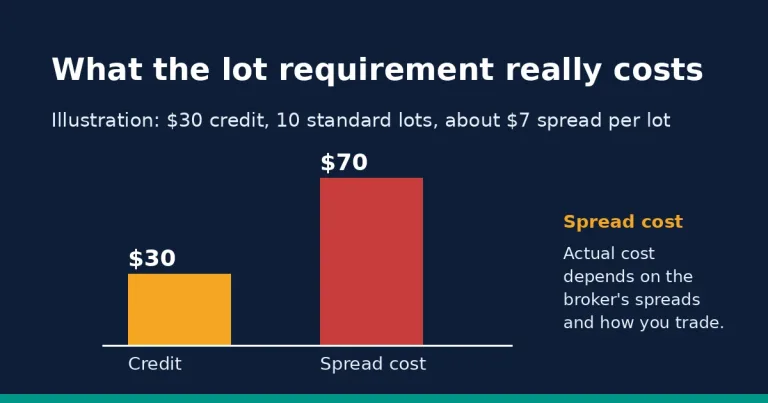
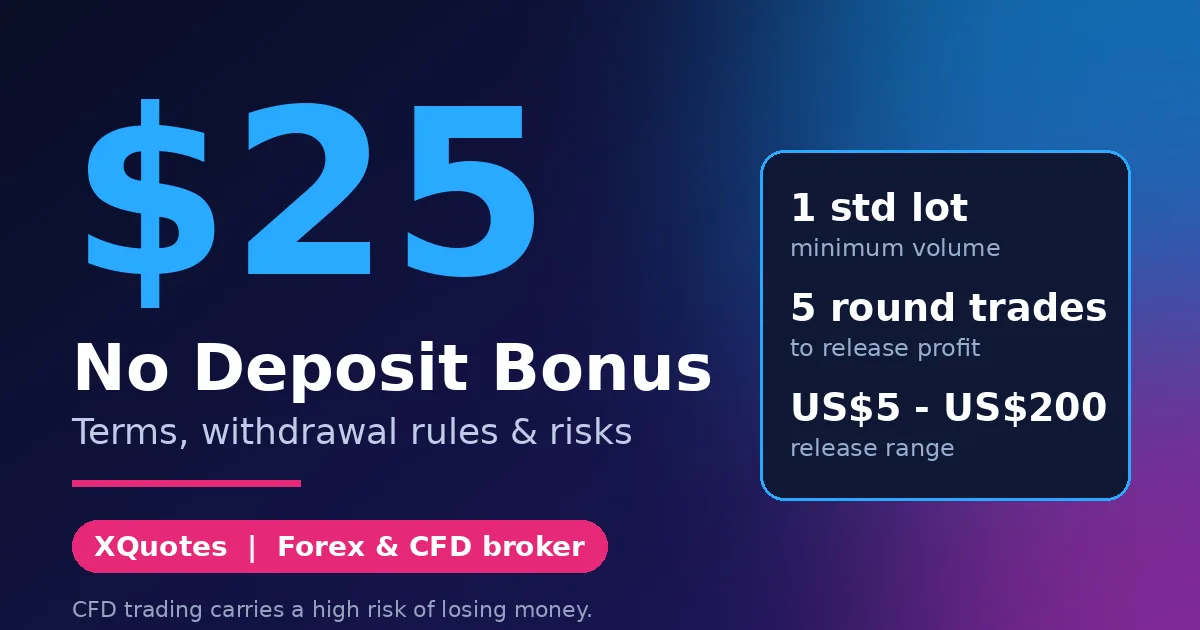
- Volume: at least 1 qualifying standard lot traded in total. A standard lot is 100,000 units of the base currency, so this usually means larger positions than many beginners expect.
- Round trades: at least 5 qualifying round trades. A round trip is one position opened and then fully closed. Its volume counts only once the position is completely closed, and partial closes do not create extra round trades. There is no minimum holding period, so short trades are not disqualified for being short.
Every bonus-funded position must be closed before you submit a release request. Each release must be at least US$5, and total releases per client, including any transfer to another wallet you authorise, cannot exceed US$200.
How the credit is reduced on each release
Each release also reduces the remaining credit. The deduction is calculated as:
Remaining credit before the release × (profit released ÷ eligible unreleased profit before the release), capped at the remaining credit.
Here is a simple example. Say you hold US$25 of remaining credit, have US$50 of eligible unreleased profit, and request a US$10 release. The deduction is 25 × (10 ÷ 50) = US$5, leaving US$20 of credit. Releasing all eligible profit, or reaching the US$200 cap, removes whatever credit is left. If your eligible unreleased profit is zero or negative, no release is processed.
Credit removal can also affect your available margin and any open positions, so watch your account after each release.
Why "no deposit" does not mean risk-free
The phrase describes how the account is opened. It does not mean there is no cost or risk. A no-deposit bonus is temporary trading credit with written conditions attached, and those conditions set the practical limits. Industry commentary also points out that most no-deposit bonus contracts make the credit non-withdrawable, so read the terms closely before you trade.
Leveraged trading carries a real chance of loss. Independent broker reviews often cite figures suggesting that most retail CFD accounts lose money. XQuotes' own documentation states that CFDs are leveraged products and carry a high risk of losing money rapidly. Treat the US$25 as a way to see how the platform behaves, not as a source of income.
Terms to double-check before you claim
One point needs confirming directly with XQuotes. The programme overview says that clients who claim this bonus may become eligible for the deposit welcome campaign after completing it. The formal terms, however, state that clients who claim the no-deposit bonus cannot take part in either tier of the deposit campaign. Ask XQuotes support or check the Client Portal before you plan around either outcome.
A simple plan for working through the offer
- Read the full terms first. Review the bonus conditions in the Client Portal before you register, so you know what counts toward a release.
- Verify your identity and address early. Verification delays can hold up everything else.
- Track your progress. Log lots traded, round trades completed, open bonus positions and each release amount, so you can check the deduction yourself.
- Avoid forcing volume. Oversized positions taken just to reach 1 standard lot are one of the fastest ways to lose more than the credit is worth.
- Close every bonus position before requesting a release. One open position can block the release you expected.
- Practise on a demo account if you are new. It lets you learn order types and the platform without touching the credit.
- Keep your trading clean. XQuotes prohibits latency arbitrage, exploiting delayed or incorrect prices, coordinated hedging, fake or duplicate claims, and bonus or cashback arbitrage. It can disqualify a client, remove credit and cancel attributable profits, with written notice.
Common mistakes to avoid
- Treating the US$25 as cash. It is trading credit, and the credit itself cannot be withdrawn.
- Ignoring the lot requirement. Many small trades never add up to 1 standard lot, so no release is possible.
- Forgetting about open positions. A single bonus trade left open can delay a release.
- Miscounting round trades. A partly closed position does not count as a round trade until it is fully closed.
- Expecting cashback. Bonus-funded activity earns no cashback or rebates.
- Opening more than one account. Duplicate claims are checked across households, devices, IP addresses and payment methods.
Is the offer worth claiming?
For someone who wants to test execution, the platform and the account process, a no-cost credit can be a low-stakes way to start. For someone hoping the credit will meaningfully grow a balance, the numbers are modest: a US$25 credit, releases of at least US$5 each, deductions on every release, and a US$200 ceiling. Weigh the offer against your own goals, and treat any profit as a bonus rather than a plan.
Frequently asked questions
Can I withdraw the US$25 directly? No. The credit itself is not withdrawable. Only eligible profits can be released, and only after the conditions are met.
How many times can I claim it? Once per client and once per household.
What is the minimum release amount? Each release must be at least US$5.
What is the maximum amount I can release? Total releases are capped at US$200 per client, including authorised transfers to another wallet.
Does the credit get reduced when I release profit? Yes. Each release reduces the remaining credit in proportion to the profit released against your eligible unreleased profit, capped at the credit left.
Does trading with the bonus earn cashback? No. Bonus-funded trading earns no cashback, self-rebates or partner commissions.
Can XQuotes change or end the offer? Yes, with notice on its website. Bonuses already credited follow the terms in force when they were credited.
Ready to look at the offer?
Claim the XQuotes $25 Free No Deposit Bonus here and read the full terms before you begin.
Risk warning: CFDs are leveraged products and carry a high risk of losing money rapidly. They may not be suitable for everyone, so only trade with money you can afford to lose. Bonus credit does not remove market risk. This article is for general information only and is not financial advice. Bonus terms, eligibility and availability are set by XQuotes and may change at any time.